The decision this helps you make
A visitor choosing help in a particular community needs useful information about availability, scope, access and the next conversation. Replacing one town name with another does not answer those questions. This review checks whether a proposed local page has a distinct purpose and enough verified information to support it. It is useful for a business serving Greater Milwaukee as well as a team organizing an existing service-area catalog. It does not assume every city and service combination deserves a separate URL.
Start with the customer’s decision, not a page-count target. Google’s spam policies identify doorway abuse as a concern when similar pages are created primarily to funnel visitors elsewhere. Our checklist asks what this page helps a person decide and what makes its information accurate. A real service area should be described honestly; serving a community does not mean the business has an office there.
A local page earns its place by answering a useful local decision with information the business can verify.
The working model
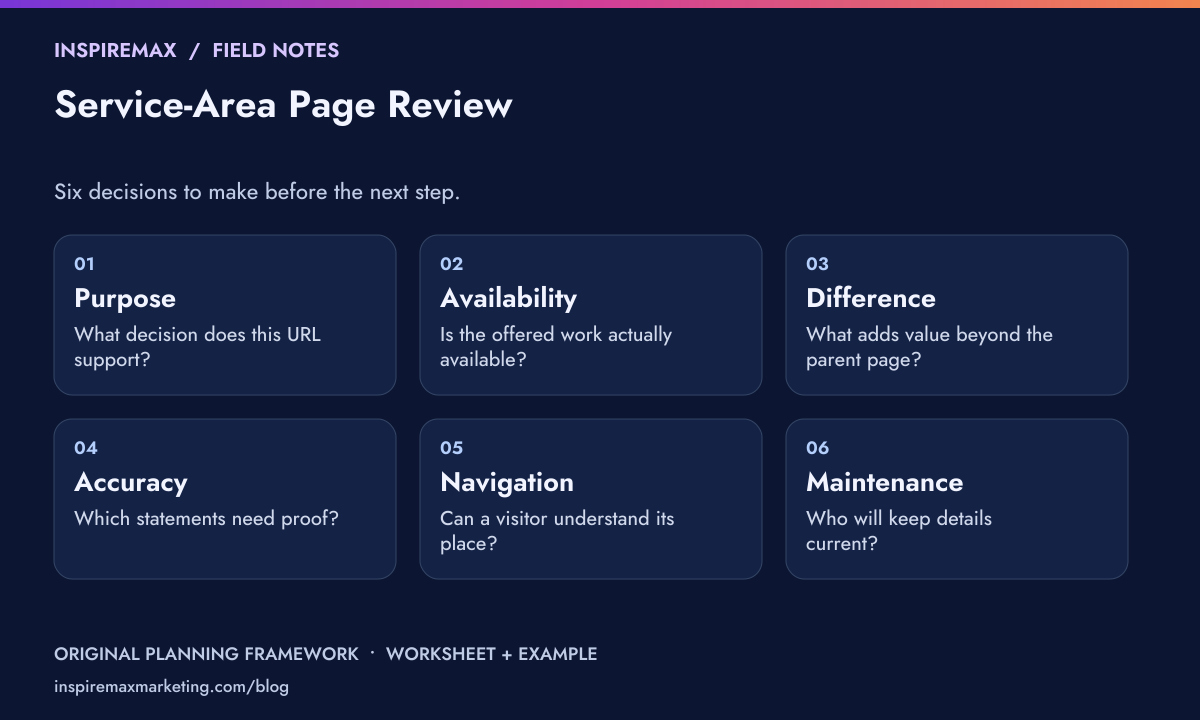
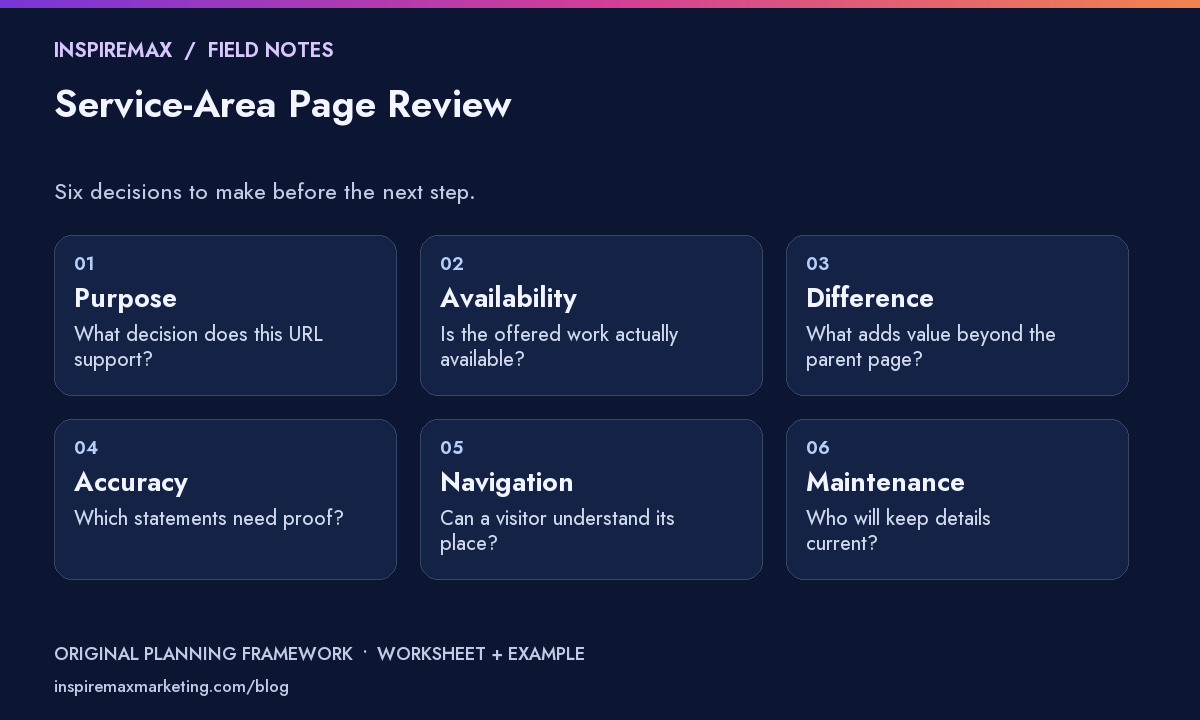
Six decisions to record
Use the questions below with the actual project information. The examples are illustrative, not client results. Download the CSV to record your answers, supporting information, decision owner and status.
| Decision | Question to resolve | Illustrative example |
|---|---|---|
| Purpose | What decision does this URL support? | A defined service and a meaningful planning question |
| Availability | Is the offered work actually available? | Business-confirmed scope and coverage |
| Difference | What adds value beyond the parent page? | Specific, relevant and verifiable guidance |
| Accuracy | Which statements need proof? | Locations, projects, credentials and factual details |
| Navigation | Can a visitor understand its place? | Clear parent, related service and inquiry links |
| Maintenance | Who will keep details current? | An owner for review and corrections |
Step 01
Write the page's distinct job
Identify the service question and the intended visitor. Ask what this URL adds beyond the main service page and nearby local pages. If the answer is only a location word, investigate whether a stronger shared resource would serve the visitor better.
Step 02
Collect verified local scoping details
Use relevant public sources and business-confirmed capabilities. Discuss actual logistics or project planning where those details matter. Avoid unsupported claims about local customers, offices, results or partnerships. A primary local source can inform context without proving the business has completed work there.
Step 03
Review the whole path
Link the page to an understandable service-area structure and a relevant service explanation. Give the visitor a clear inquiry route. Check that related pages support navigation rather than repeating the same introduction in dozens of places.
Apply the method
A worked example
Illustrative example: two neighboring-community pages describe the same service with the same general paragraphs. A review may find no useful distinction. Rather than add unverified landmarks to make them look different, clarify their purpose and consider whether the shared service page or a substantive planning guide answers the question better. If a distinct local issue genuinely affects the work, explain it with an appropriate primary source and accurate business scope. The page should earn its place by helping the visitor.
Before you call it complete
- Can the team state a distinct visitor need?
- Are offices and local work described truthfully?
- Does local context affect the actual project decision?
- Is there useful information beyond a renamed introduction?
- Does the page fit a navigable, maintainable structure?
Reference and attribution
This is an original InspireMax editorial framework, with a primary reference for the related guidance: Google Search Central: spam policies ↗. The worksheet and examples are planning aids, not measured performance benchmarks.
Cite this resource
InspireMax Marketing. “A Service-Area Page Review: Is There a Useful Reason for This Page to Exist?.” November 7, 2026. https://inspiremaxmarketing.com/blog/service-area-page-review-checklist/
Found something that needs correction? Tell us which resource and detail to review.
Put the plan to work
Planning a project in Greater Milwaukee?
InspireMax brings strategy, design and production together. Tell us what you are trying to accomplish, what you already have and the timing you are considering. We will discuss the scope and practical next steps.