The decision this helps you make
A redesign changes more than the homepage. Existing service pages, articles, forms and old campaign URLs can carry useful information or lead visitors into obsolete experiences. A page inventory makes those decisions visible before new layouts replace them. Use it to decide what to keep, improve, consolidate or retire. It is especially helpful when the current site has grown through several separate projects and nobody has a complete record of why every URL exists.
Keep the content decision separate from the URL decision. A page may need new writing while retaining its address, or it may be consolidated into a stronger destination. Google’s site-move guidance describes the importance of URL mapping when addresses change. Our inventory adds the business review: what job the page performs, which evidence informs the decision and who can accept the proposed treatment.
A redesign inventory protects useful decisions by recording what every existing URL is supposed to become.
The working model
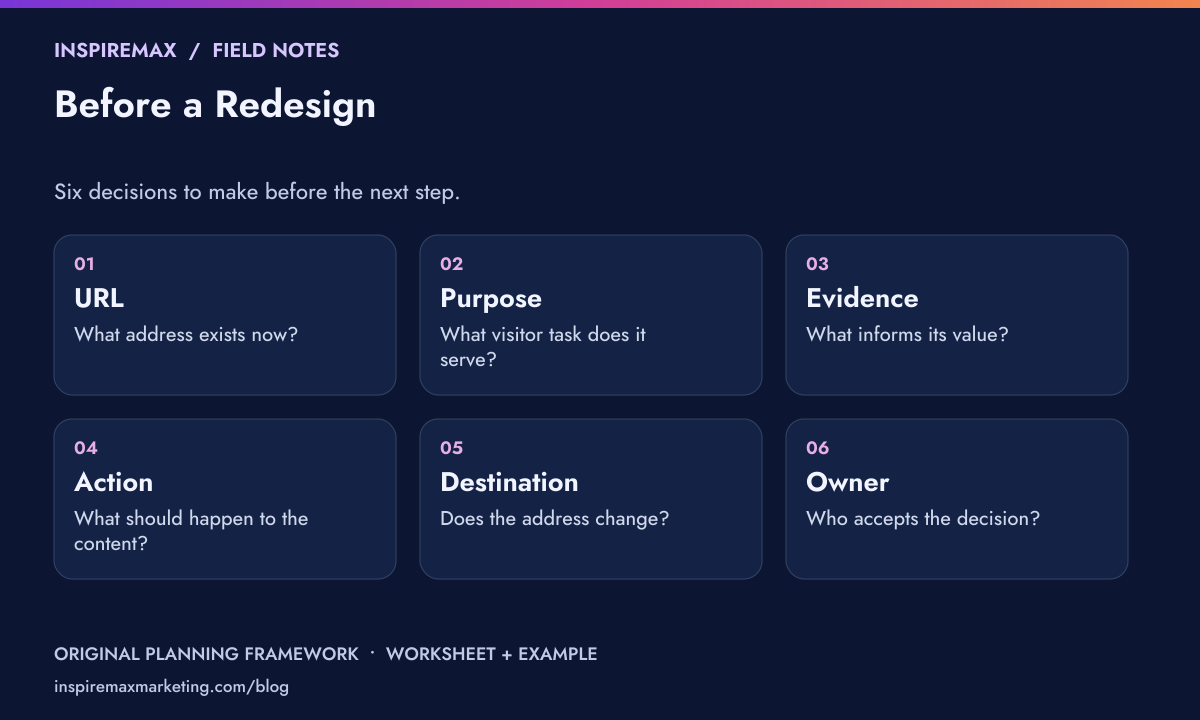
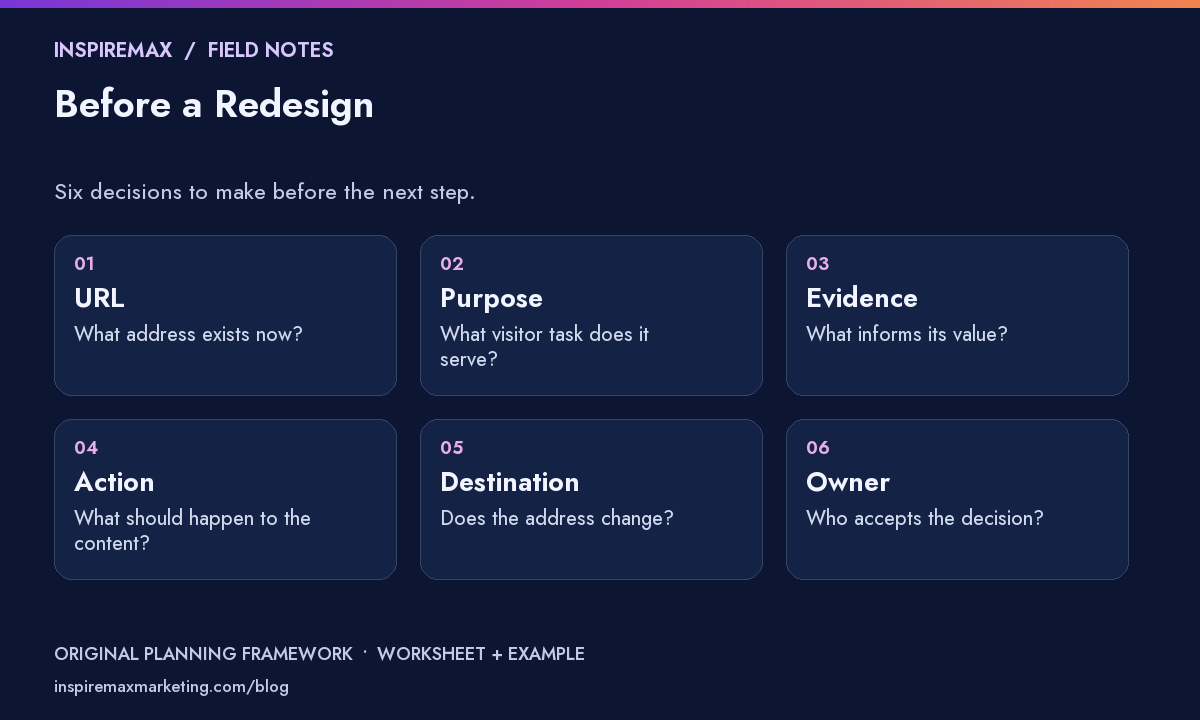
Six decisions to record
Use the questions below with the actual project information. The examples are illustrative, not client results. Download the CSV to record your answers, supporting information, decision owner and status.
| Decision | Question to resolve | Illustrative example |
|---|---|---|
| URL | What address exists now? | Record the exact path and observed status |
| Purpose | What visitor task does it serve? | A service decision, resource or inquiry |
| Evidence | What informs its value? | Available traffic, links, leads and business context |
| Action | What should happen to the content? | Keep, improve, consolidate or retire |
| Destination | Does the address change? | Specify the appropriate new location when needed |
| Owner | Who accepts the decision? | A business reviewer and implementation owner |
Step 01
Build a real URL list
Combine the sitemap, a crawl and known campaign or legacy addresses. A sitemap alone may omit useful or problematic pages. Record status, canonical destination and whether the URL is part of a current visitor path.
Step 02
Review purpose and evidence
Identify the intended task, factual owner and available performance context. A lack of traffic is not by itself proof that a page has no value; it may support a narrow customer need. Distinguish measured behavior from assumptions about what visitors do.
Step 03
Choose treatment and verify it
Assign a clear action to each URL, including any replacement destination. Keep the map available during development and after launch. Test important old addresses and new internal links, then document exceptions rather than leaving them as unexplained redirects.
Apply the method
A worked example
Illustrative example: three old pages explain different aspects of the same service. The inventory may support preserving one useful page, expanding it and mapping appropriate old URLs to that destination. The decision should consider content, existing links and visitor intent, not merely which URL looks shortest. Test the resulting path and update internal links to the intended final destination. Keep a dated record so a future editor understands why a page was consolidated.
Before you call it complete
- Does the inventory include known legacy URLs?
- Is each page's job stated?
- Are decisions based on available evidence and business context?
- Are changed addresses mapped deliberately?
- Have old and new paths been checked after launch?
Reference and attribution
This is an original InspireMax editorial framework, with a primary reference for the related guidance: Google Search Central: URL changes and site moves ↗. The worksheet and examples are planning aids, not measured performance benchmarks.
Cite this resource
InspireMax Marketing. “Before a Redesign: The Page-Inventory Decision Sheet.” November 10, 2026. https://inspiremaxmarketing.com/blog/before-redesign-page-inventory/
Found something that needs correction? Tell us which resource and detail to review.
Put the plan to work
Planning a project in Greater Milwaukee?
InspireMax brings strategy, design and production together. Tell us what you are trying to accomplish, what you already have and the timing you are considering. We will discuss the scope and practical next steps.