The decision this helps you make
A visually impressive room may be difficult for an interview if the sound changes every few seconds. Ventilation, traffic, nearby conversations and reflective surfaces can complicate a recording plan. This location check helps a business coordinate with the production team before committing to a room. It does not replace a sound professional’s judgment or guarantee that a location will work. It makes the questions about noise, access and interruptions easier to answer while there is still time to consider alternatives.
Evaluate the room under realistic conditions. A quiet moment during a tour may not represent the period when the interview will happen. Shure’s recording-environment guidance discusses the role of a quiet, suitable space. Our worksheet focuses on the business coordination around that choice: when the room is used, what can change and who can authorize practical adjustments.
The right interview location is a coordinated sound and access decision, not only an attractive background.
The working model
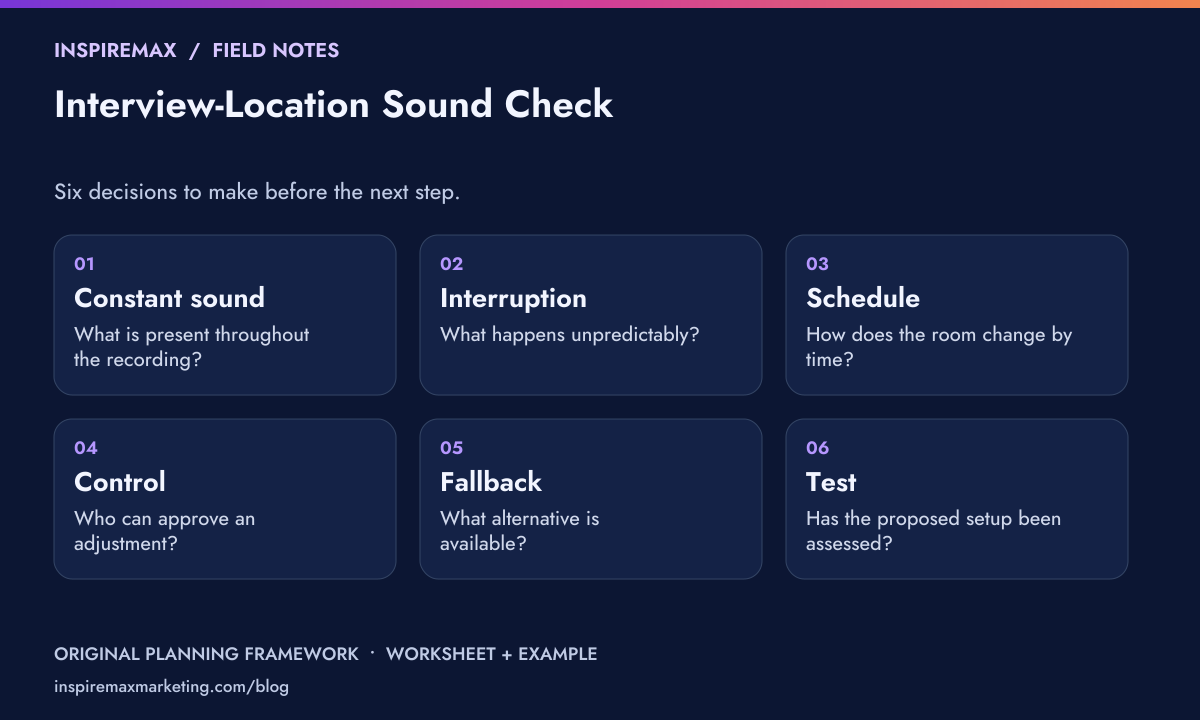
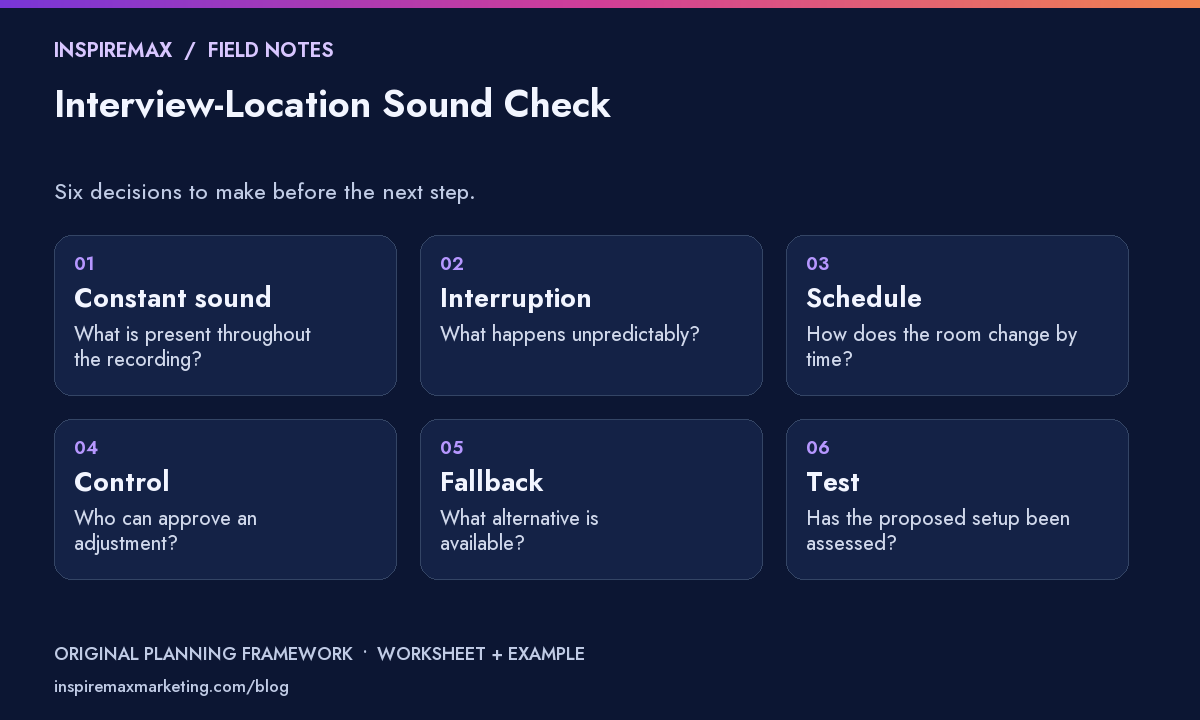
Six decisions to record
Use the questions below with the actual project information. The examples are illustrative, not client results. Download the CSV to record your answers, supporting information, decision owner and status.
| Decision | Question to resolve | Illustrative example |
|---|---|---|
| Constant sound | What is present throughout the recording? | Ventilation, machinery or other ongoing activity |
| Interruption | What happens unpredictably? | Calls, traffic, deliveries or nearby conversations |
| Schedule | How does the room change by time? | Meetings, occupancy or operational activity |
| Control | Who can approve an adjustment? | The person responsible for the space or system |
| Fallback | What alternative is available? | A second room with understood limitations |
| Test | Has the proposed setup been assessed? | Production review with realistic conditions |
Step 01
Listen at the planned time
Visit or assess the room when normal activity resembles the intended recording period. Note persistent sound and intermittent interruptions separately. Share a useful description with the producer; “quiet office” can mean different things to different people.
Step 02
Identify what can be controlled
Ask about adjacent meetings, deliveries, machinery and ventilation. Any operational change needs approval from the responsible person; never assume equipment or building systems can simply be switched off. Record a fallback space if the preferred location is uncertain.
Step 03
Test the complete setup
The production team should assess sound with the proposed recording approach. Check participant comfort, interruptions and the visual background together. A location decision is stronger when the tradeoffs are explicit rather than discovered after people are already waiting to be interviewed.
Apply the method
A worked example
Illustrative example: a conference room looks appropriate during a short tour but shares a wall with a busy meeting space. The interview is planned for the same time as a recurring group session. The worksheet reveals the overlap. The organizer can ask about another time or room before participants arrive. If neither is available, the producer can evaluate the actual situation and propose an approach without relying on a vague promise that the space will probably be quiet.
Before you call it complete
- Has the location been considered at the intended time?
- Are constant and intermittent sounds distinguished?
- Are operational adjustments authorized by the right person?
- Is a fallback understood?
- Has the production team assessed the real setup?
Reference and attribution
This is an original InspireMax editorial framework, with a primary reference for the related guidance: Shure: choosing a recording environment ↗. The worksheet and examples are planning aids, not measured performance benchmarks.
Cite this resource
InspireMax Marketing. “The Interview-Location Sound Check: Listen Before Choosing the Background.” November 12, 2026. https://inspiremaxmarketing.com/blog/interview-location-sound-check/
Found something that needs correction? Tell us which resource and detail to review.
Put the plan to work
Planning a project in Greater Milwaukee?
InspireMax brings strategy, design and production together. Tell us what you are trying to accomplish, what you already have and the timing you are considering. We will discuss the scope and practical next steps.